Some books inform you. Others stay with you for a lifetime.
For me, Life Together by Dietrich Bonhoeffer has become one of the latter. I’ve returned to it multiple times since 2020, including a recent read-through just a couple of weeks ago. Somehow, it still speaks with brand‑new clarity each time I pick it up.
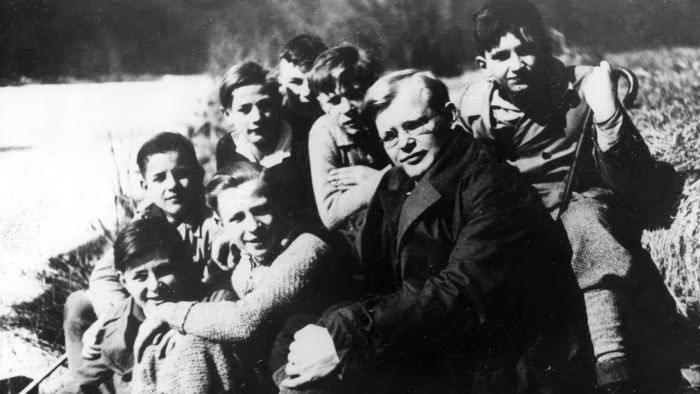
Part of the reason why may be the context in which it was written. Bonhoeffer wrote Life Together from his experience leading an underground seminary in Nazi Germany. There, community wasn’t theoretical or sentimental. Instead, it was fragile, costly, and incredibly dangerous. Case in point: after the seminary was shut down by the Gestapo, Bonhoeffer was imprisoned and ultimately executed for resisting Hitler’s regime.
This reality dwells on every page of the book. In it, Bonhoeffer isn’t waxing poetic on abstract theology or spiritual idealism. As John Doberstein notes in the introduction, he writes with “an insistent realism,” with a conviction that our faith is shaped through everyday life with others.
Neighboring as Real-Life Community
At NeighborLink, we often describe our work as connecting neighbors in need with neighbors who can help. On the surface, that sounds simple. Projects get completed, needs are met, and everyone walks away grateful.
But anyone who has served for any length of time knows that neighboring is far more complex than simply checking a task off a to-do list. Bonhoeffer helps explain why:
“The first service that one owes to others consists in listening to them.”
This insight has shaped me more than almost any other since joining the NeighborLink team in January 2020. When I transitioned from the entrepreneurial world into nonprofit work, I stepped into a role centered on storytelling. At first, I assumed storytelling meant learning to communicate in an intriguing and effective way. Over time, I realized it begins with something deeper:
Learning how to listen well.
Listening changes the way you see people. You stop seeing a project request and start seeing the exhausted daughter caring for her aging mother. You stop seeing an overgrown lawn and begin seeing a neighbor whose physical limitations have slowly isolated them from the outside world. You begin to recognize that many people are carrying burdens invisible to everyone around them.
This is why NeighborLink’s work is not just about completing more projects than the year before. It’s about so much more than that.
Seeing Christ in the “Weak and Insignificant”
Bonhoeffer understood that Christian community is never built around presumed usefulness or outward appearances. In one of the book’s most challenging sections, he writes:
“The exclusion of the weak and insignificant, the seemingly useless people, from a Christian community may actually mean the exclusion of Christ.”
Wow. Talk about cutting against the grain of modern society.
We live in a culture that often values people based on productivity or what they can contribute. But neighboring calls us into a different way of seeing and doing. It reminds us that people matter not because of what they offer, but because they bear the image of God.
When this truth sinks in, helping becomes less transactional and more relational. Listening becomes just as important as fixing. Presence matters even more than productivity.
The Unromantic Work of Real Community
Of course, this kind of community is easy to romanticize. It’s tempting to imagine a perfect version of life together. One without conflict, inconvenience, or the slightest negativity. Bonhoeffer warns against this. He argues that idealism can actually destroy community because it refuses to deal with people as they really are.
Real community involves interruption. It involves bearing one another’s burdens. It requires patience, humility, forgiveness, and the willingness to remain present when things become difficult.
That’s the kind of neighboring we hope to cultivate at NeighborLink. Not polished. Never performative. Just ordinary people choosing to move toward one another in love, one day at a time.
Some of the most meaningful moments in neighboring don’t happen during the work itself. They happen in conversations on front porches and in driveways. Moments when someone realizes they are seen, heard, and not alone. Bonhoeffer seems to confirm this:
“The physical presence of other Christians is a source of incomparable joy and strength to the believer.”
I think many people today are starving for this kind of presence in their lives.
Why Life Together Still Matters
Perhaps that’s why Life Together continues to resonate nearly 100 years after it was written. It reminds us that community is not something we manufacture through strategy or branding. It is something we receive, practice, and participate in together.
In a world increasingly marked by isolation, suspicion, distrust, and division, neighboring becomes more than random kindness.
It becomes our very way of doing life together.\
*
Robert Johnson
Director of Formation, NeighborLink Foundation Inc
Robert is the Director of Formation at NeighborLink. Before stepping into this role, he served for six years on staff with NeighborLink Fort Wayne, most recently as Director of Communications and Development. Robert enjoys telling stories about neighbors and the transformational impact of neighboring. Outside of work, he loves traveling with his family, reading, and pursuing a life shaped by the Gospel.